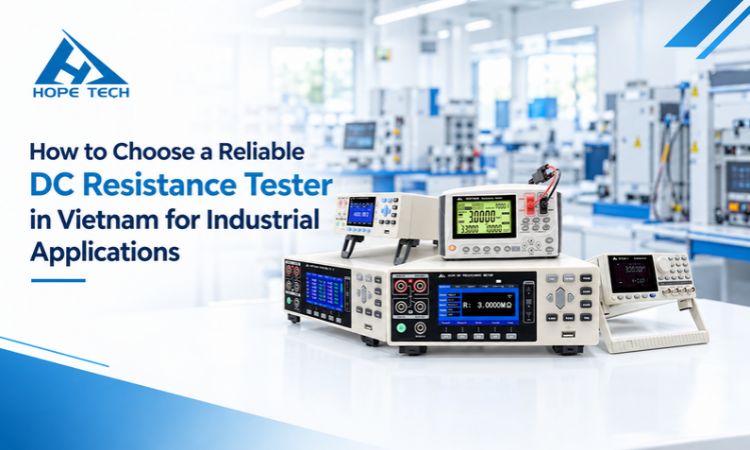
Electrical components need to perform consistently to support the safety, efficiency, and reliability of modern equipment. Even a small change in resistance can indicate a loose connection, damaged winding, or variation in a conductive component. Accurate resistance measurement helps manufacturers identify these issues during production, inspection, and maintenance.
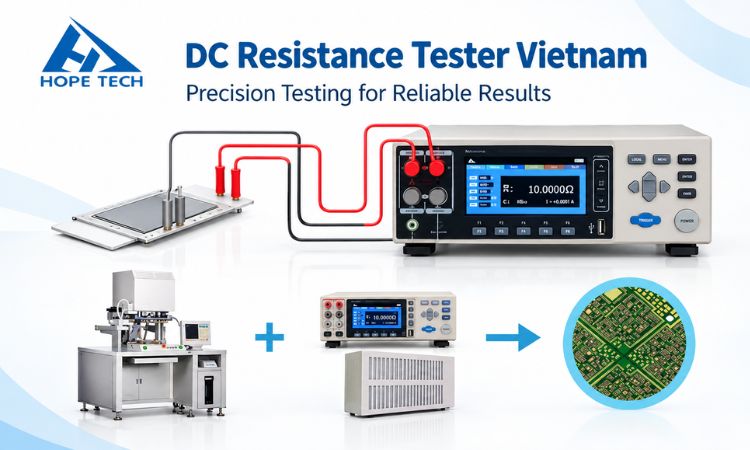
For businesses looking for a DC Resistance Tester Vietnam, selecting the right instrument involves more than comparing prices. Measurement accuracy, resistance range, testing speed, and compatibility with the intended application all influence the suitability of a testing solution.
Hope Instruments provides electrical test and measurement equipment for industrial manufacturing, electronics, battery testing, automotive components, and other technical applications. Understanding how a DC resistance tester works can help businesses choose equipment that meets their specific testing requirements.
Why Is DC Resistance Testing Important?
DC resistance testing measures the opposition a component offers to direct current. It is commonly used to evaluate electrical connections, conductive materials, coils, windings, and electronic components.
In manufacturing environments, resistance measurements help verify whether components meet predefined quality requirements. They can also help identify inconsistencies before products move to the next stage of production.
For example, manufacturers testing electrical connectors may use resistance measurements to assess the conductivity of contact points. Similarly, transformer and motor manufacturers can measure winding resistance to identify differences that may require further investigation.
Regular testing can support quality control, troubleshooting, and maintenance planning. However, resistance results should always be interpreted according to the component specifications and the requirements of the particular application.
Applications of DC Resistance Testers in Different Industries
A DC resistance tester can serve several purposes depending on the equipment being tested and the required measurement range.
- Electrical Components and Electronics: Electronic manufacturers need reliable measurements when inspecting resistors, inductors, switches, relays, connectors, and other conductive components. A suitable tester helps technicians identify resistance variations and check whether components meet established specifications. High-resolution measurement can be particularly valuable when working with low-resistance components where even minor differences matter.
- Transformer and Motor Testing: Transformer windings and motor coils require appropriate resistance measurements during manufacturing and maintenance. Changes in measured resistance can help technicians identify potential issues that need additional inspection. The instrument should offer a suitable measurement range, accuracy, and test method for the equipment being evaluated.
- Battery and Energy Storage Applications: Battery systems and energy storage equipment depend on reliable electrical connections. Resistance testing can help assess conductive paths, terminals, and related components during production and inspection. It is important to distinguish between a DC resistance tester and a battery internal resistance tester. Although their applications can overlap, the appropriate instrument depends on whether the requirement is to measure component resistance or evaluate a battery using a dedicated testing method.
- Cable and Connector Manufacturing: Cable manufacturers and automotive electronics suppliers use electrical testing to verify connections and conductive pathways. Resistance measurements can help identify poor contacts, inconsistent connections, and other issues that may affect product performance. For production facilities handling multiple components, faster measurements and suitable automation interfaces can also improve inspection workflows.
What Should You Consider When Choosing a DC Resistance Tester?
When evaluating a DC Resistance Tester Vietnam, businesses should assess the instrument against their actual testing needs rather than selecting equipment based on a single specification.
- Measurement range: Choose an instrument that covers the resistance values of the components you need to test. Some applications require micro-ohm measurements, while others involve higher resistance values.
- Accuracy and resolution: Accuracy indicates how close a measurement is to the actual value, while resolution describes the smallest displayed increment. Both matter when inspecting precision components or comparing small resistance differences.
- Four-wire measurement: Four-wire testing, also known as Kelvin measurement, helps reduce the influence of test-lead resistance. This is especially useful for low-resistance measurements where the resistance of the leads could otherwise affect the result.
- Testing speed: Production facilities may need rapid, repeatable measurements to inspect large quantities of components efficiently. Laboratories may place greater emphasis on precision and measurement flexibility.
- Connectivity and automation: Communication interfaces and external control options can help integrate testing equipment into automated production lines, depending on the instrument’s capabilities.
- Portability: For field inspections and maintenance work, a handheld tester may be more practical than a benchtop instrument. The right choice depends on where measurements will take place and the type of equipment involved
DC Resistance Testing Solutions from Hope Instruments
Hope Instruments offers a range of resistance testing equipment designed for laboratory measurement, production inspection, and field applications. Its portfolio includes benchtop resistance testers, high-speed instruments, multi-channel models, and portable testers.
The HT3544 DC Resistance Tester is designed for applications that require accurate measurements, including motor and coil testing. Depending on the selected configuration, related models also offer multi-channel testing for applications that involve inspecting multiple components.
For mobile testing requirements, the HT3548 Handheld Resistance Tester provides a portable option. It supports a measurement range of 0.1 μΩ to 3.3 MΩ, with basic accuracy of 0.02%, making it suitable for a range of resistance measurement and maintenance applications.
Businesses should compare the specifications of individual models to determine which instrument matches their required measurement range, test speed, accuracy, and working environment.
How Can the Right Tester Improve Quality Control?
A suitable resistance tester can help establish more consistent inspection procedures across manufacturing and maintenance operations.
When measurements are performed using appropriate methods and predefined acceptance limits, quality teams can identify components that require further investigation. Recording test results can also help businesses compare production batches, monitor recurring issues, and maintain inspection records.
For manufacturers with high testing volumes, multi-channel equipment may help streamline repetitive measurement tasks. For maintenance teams, a portable instrument can make on-site checks more convenient.
These benefits depend on selecting suitable equipment, maintaining proper calibration, following recommended test procedures, and interpreting measurements against relevant technical specifications.
Finding a DC Resistance Tester in Vietnam
Choosing a DC Resistance Tester Vietnam requires an understanding of the components being tested, the expected resistance values, and the operating environment. Manufacturers should also consider whether they need a benchtop instrument, a handheld tester, or a multi-channel solution for production testing.
Hope Instruments provides electrical testing solutions for applications involving electronic components, motors, coils, batteries, cables, and other industrial products. Reviewing the available models and their technical specifications can help businesses identify equipment suited to their testing processes.
To explore suitable resistance measurement equipment, contact the Hope Instruments team to discuss your application, measurement requirements, and preferred testing configuration.