Battery performance depends on more than voltage and capacity. Internal resistance is another important measurement that can provide useful information about battery condition, performance, and consistency. For manufacturers, laboratories, research teams, and battery service professionals, having accurate testing equipment can make battery evaluation more efficient and reliable.
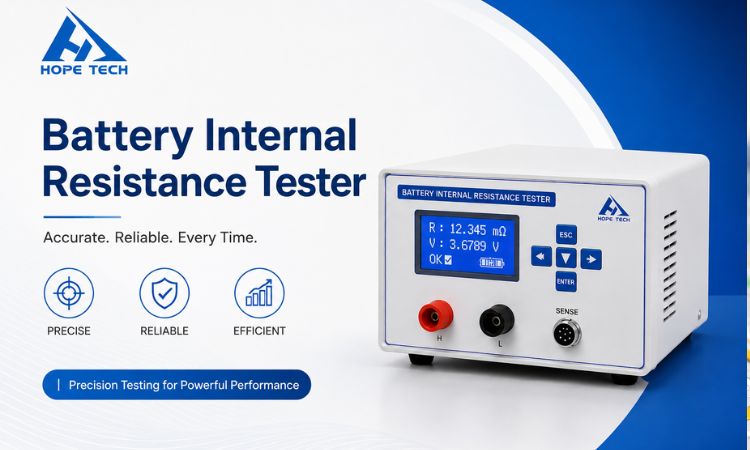
An Internal Resistance Tester in United States can help businesses measure battery resistance and voltage with precision while supporting quality control and research requirements.
HopeInstruments offers a range of battery testing solutions designed for different battery types, applications, and testing environments.
Why Battery Internal Resistance Matters
Every battery has some level of internal resistance. As a battery changes over time, its internal resistance can also change. Measuring this value can help identify differences between batteries and provide useful information for evaluating battery condition.
Internal resistance testing is particularly valuable when batteries need to be inspected in large quantities. Instead of relying only on basic voltage measurements, technicians and manufacturers can use resistance measurements to gain a better understanding of battery performance.
For production environments, accurate measurements can also help with battery sorting and quality inspection. Hope Instruments’ battery testers are designed for applications including battery research and development, production inspection, and testing of low-resistance batteries.
Choosing the Right Internal Resistance Tester
Not every battery testing application has the same requirements. A laboratory testing individual cells may need different equipment from a production line testing hundreds of batteries.
When choosing an Internal Resistance Tester in United States, consider factors such as measurement range, resolution, testing speed, battery voltage, portability, and communication capabilities.
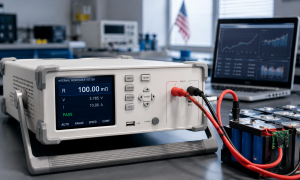
For example, the HopeInstruments HT3563 uses a four-wire measurement method and can measure internal resistance and battery voltage simultaneously. Its resistance measurement range extends from 3 mΩ to 3 kΩ, with a minimum resolution of 0.1 μΩ.
For smaller batteries and battery packs, the HT3561 offers a more compact testing solution. It supports battery internal resistance and voltage testing and can also be integrated into automated testing systems.
Applications Across the Battery Industry
Internal resistance testing can be useful across several stages of battery development and production. It can support research, manufacturing inspection, battery sorting, and performance evaluation.
Common applications include:
- Lithium battery testing
- Battery pack inspection
- Production-line quality control
- Research and development
- Energy storage battery testing
- Fuel cell stack inspection
- Battery degradation and life assessment
HopeInstruments’ HT3563 series, for example, is designed for low-resistance batteries, large lithium battery packs, high-volume production inspection, fuel cell stack inspection, and battery R&D.
Four-Wire Measurement for Better Accuracy
Measurement accuracy becomes particularly important when testing batteries with very low internal resistance. Small measurement errors can affect the reliability of test results.
The four-wire, or Kelvin, measurement method helps reduce the influence of lead and contact resistance during low-resistance measurements. HopeInstruments uses a four-wire measurement approach in several of its battery testers to support stable and precise measurements.
This can be especially useful for manufacturers and laboratories where consistent measurements are important for comparing batteries and identifying variations.
Testing for Production and Automation
Modern battery manufacturing often requires fast and repeatable testing. A tester that can communicate with other equipment can make it easier to incorporate battery inspection into an automated production process.
The HT3561 supports interfaces including RS232, RS485, LAN, and Handler, along with SCPI and Modbus communication protocols. This makes it suitable for automated battery measurement and production-line applications.
For businesses testing multiple batteries simultaneously, HopeInstruments also offers multi-channel options. The HT3563-12H and HT3563-24H can support testing across up to 24 channels, making them useful for batch testing and automated production requirements.
Portable Testing for Field Applications
Not every battery needs to be tested inside a laboratory. Some applications require technicians to evaluate batteries where they are installed.
The HT3554 handheld battery tester is designed for backup UPS and lead-acid batteries and can measure internal resistance and voltage. Its design supports on-site testing and rapid battery diagnosis. The instrument can also store measurement data for later review.
This type of portable solution can be useful for maintenance teams that need to inspect battery systems without moving them to a dedicated testing area.
High-Voltage Battery Testing
As battery systems become larger and more powerful, testing equipment also needs to handle higher voltage requirements. HopeInstruments’ HT3564 series is designed for internal resistance and voltage testing of large battery packs, with the HT3564 supporting test voltages up to 1000V.
This makes high-voltage testing equipment relevant for applications involving large battery modules, energy storage systems, and other advanced battery technologies.
Why Choose HopeInstruments?
Selecting battery testing equipment is an important decision, particularly when measurement accuracy and repeatability affect production quality. HopeInstruments provides different battery testers for laboratory, production, multi-channel, portable, and high-voltage applications.
The range allows users to select equipment according to their battery type, voltage requirements, testing environment, and production needs rather than relying on a single testing solution.
If you are looking for an Internal Resistance Tester in United States, choosing equipment with the right measurement range, accuracy, speed, and integration capabilities can help create a more dependable battery testing process.
Explore HopeInstruments‘ battery testing solutions to find equipment suited to your specific application and testing requirements.